In July 2026 the European Commission published new guidance values for mycotoxins in feed, in Commission Recommendation (EU) 2026/1801. They apply from July 1, 2027, and from October 1, 2027 for maize, sorghum, soybean, sunflower, and their products. Several values are much lower than the ones they replace, most of which date from 2006. Two examples for deoxynivalenol (DON), in mg/kg at 12% moisture:
| Feed | Until June 30, 2027 | From July 1, 2027 |
|---|---|---|
| Cereals other than maize | 8.0 | 4.0 |
| Complete feed for pigs | 0.9 | 0.7 |
A recommendation is not a law, but the Commission asks feed businesses to use these values as the critical limits in their HACCP plans, and asks national authorities to make sure they do. Take a lot of feed wheat that tests at 5.2 mg/kg DON. Today it is well inside the guidance value. From July 1, 2027 it is over it. If you make compound feed or premixes, mill grain, or crush oilseeds, the months until then are the time to make sure every lot you buy is tested, recorded, and traceable. This post looks at how CompuTec ProcessForce and CompuTec PDC help you do that in SAP Business One.
Testing Every Delivery Against the New Values
The recommendation asks for samples to be analyzed for all five mycotoxins it covers at the same time: DON, zearalenone, ochratoxin A, T-2 and HT-2 toxins, and fumonisins. It also states every value relative to a moisture content of 12%, so a result means little without the moisture of the same sample.
In CompuTec ProcessForce, a Test Protocol defines what is tested for each raw material: here, the five mycotoxins and moisture, each with its limit, so maize and wheat are each tested against their own values. When a Goods Receipt PO is posted, the Quality Control Test, or a pool of tests, can be created automatically, so the laboratory always knows which lots are waiting.
Mycotoxins are rarely spread evenly through a load, so a single sample can miss the part that matters. In a Quality Control Tests Pool, the Test Protocol sets how many samples are taken from the lot, a linked test is created for each one, and the pool passes or fails the whole lot on the acceptance and rejection numbers you define. For mycotoxins you might allow no failed samples at all.
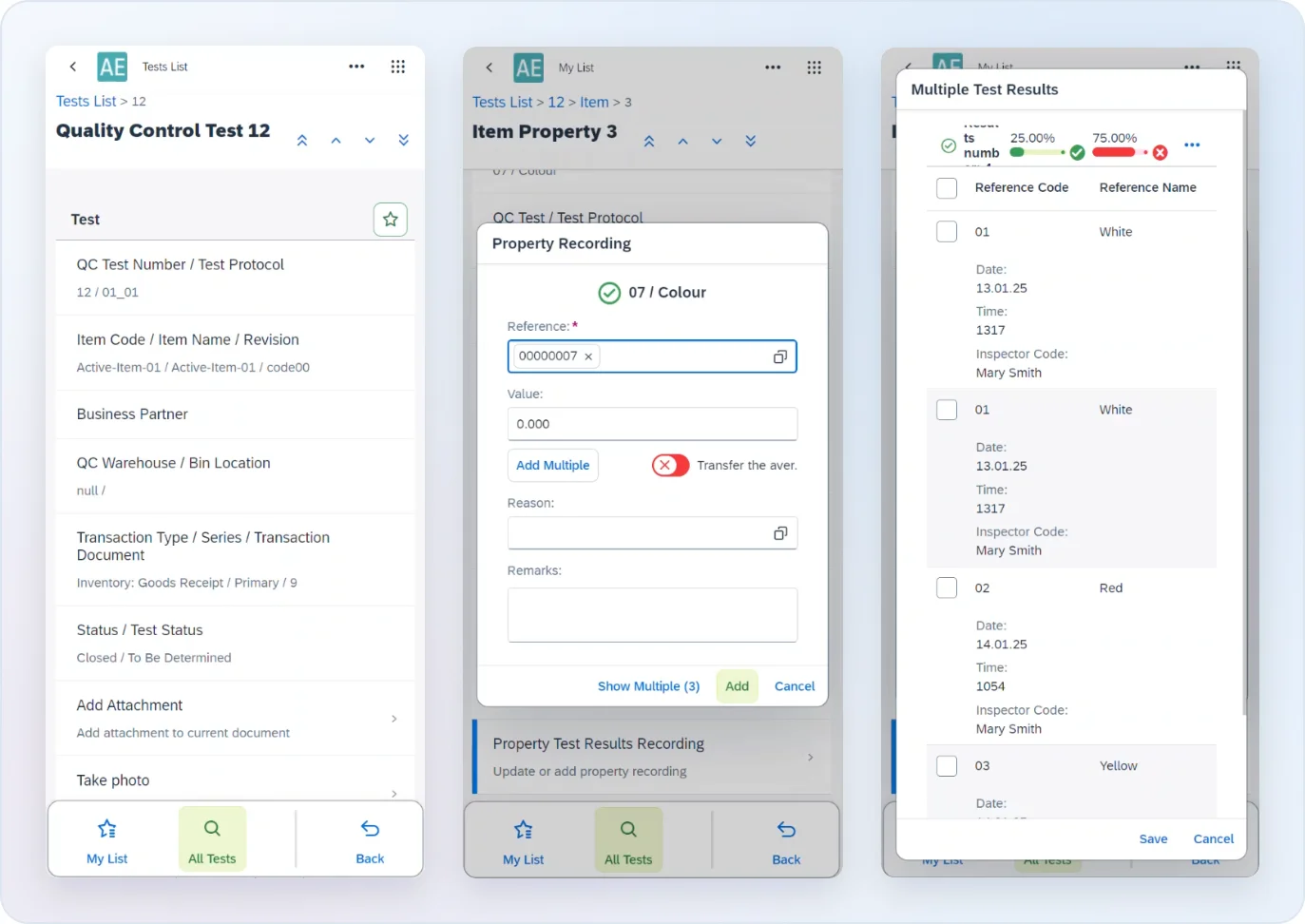
Within a single test, you can also record several results for the same property, for example when DON is analyzed twice or moisture is measured at several points in the load. Each reading is kept with its date, time, and inspector, the test shows the share that passed and failed, and for a measured value such as moisture, the average can be carried over as the test result. With the Quality Testing Mobile app, results can be entered on a tablet or phone at the intake and are recorded in CompuTec ProcessForce straight away.
Holding Each Lot Until It Passes
A test result helps only if nobody uses the grain before the result is in. Received batches can start out locked, and CompuTec ProcessForce releases them automatically once their test is passed and closed, or blocks them if it fails. A locked batch can’t be picked for a Manufacturing Order or a Delivery.
Each Goods Receipt PO can receive its batches locked and creates a Quality Control Tests Pool with one test per sample, covering the five mycotoxins and moisture. If the pool passes, the batch is released for Manufacturing Orders and Deliveries; if it fails, the batch is blocked and a Non-Conforming Materials Report records the actions taken.
Goods Receipt PO
Batches can be received locked, and the tests are created automatically
Quality Control Tests Pool
Each sample tested against the limits for this raw material
- 5 mycotoxins
- Moisture
Batch released
Available to Manufacturing Orders and Deliveries
Batch blocked
A Non-Conforming Materials Report records the actions taken
Test held until report is closedThe batch stays locked from receipt until its test is passed and closed.
Under the recommendation, feed above a guidance value should only be used or sold with precautionary measures in place, and a risk assessment is expected when the value for complete or complementary feed, or for a material fed directly to animals, is exceeded. Whatever you decide for the lot of wheat at 5.2 mg/kg, you will want a record of the decision.
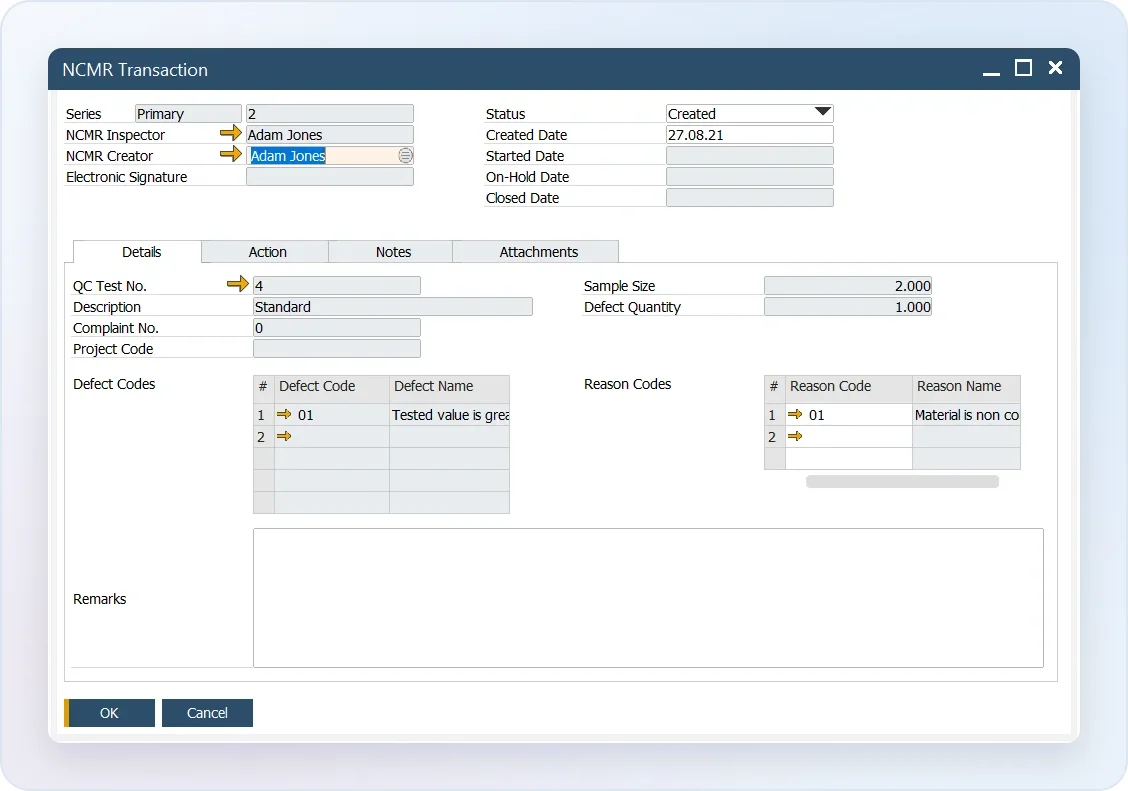
When a test fails, a Non-Conforming Materials Report records it. Details of the failed test carry over, and you add the reasons, the containment and corrective actions, and an inventory action, such as moving the lot to a separate warehouse, with an alert to the person who carries it out. Laboratory reports and the risk assessment can be attached. Raising the report moves the test to Waiting NCMR, and the test stays blocked until the report is closed, so the lot can’t be released while the failure is still open.
Knowing What Each Supplier Delivers
The recommendation also expects suppliers to give compound feed manufacturers enough information about the mycotoxin content of what they sell. Your own results are the other half of that picture. Because every test is linked to the batch you received, you build a record of what each supplier delivers, season after season.
You give each supplier a rating based on that record, and in CompuTec ProcessForce the rating decides how often its deliveries are tested: a supplier with a long run of good results less often, and a new supplier, or one below target, on every delivery. Our post on supplier quality in life sciences covers the Supplier Scorecard and rating-based testing in more detail; the functionality works the same way for the grain and oilseeds you buy.
Following a Lot Into Finished Feed
If a lot of grain turns out to be over a guidance value after it has been used, you need to know at once which batches of feed it went into and which customers received them. Batch Traceability in CompuTec ProcessForce follows each lot from the supplier’s batch through intermediate products to finished feed and the Deliveries that shipped it, in both directions.
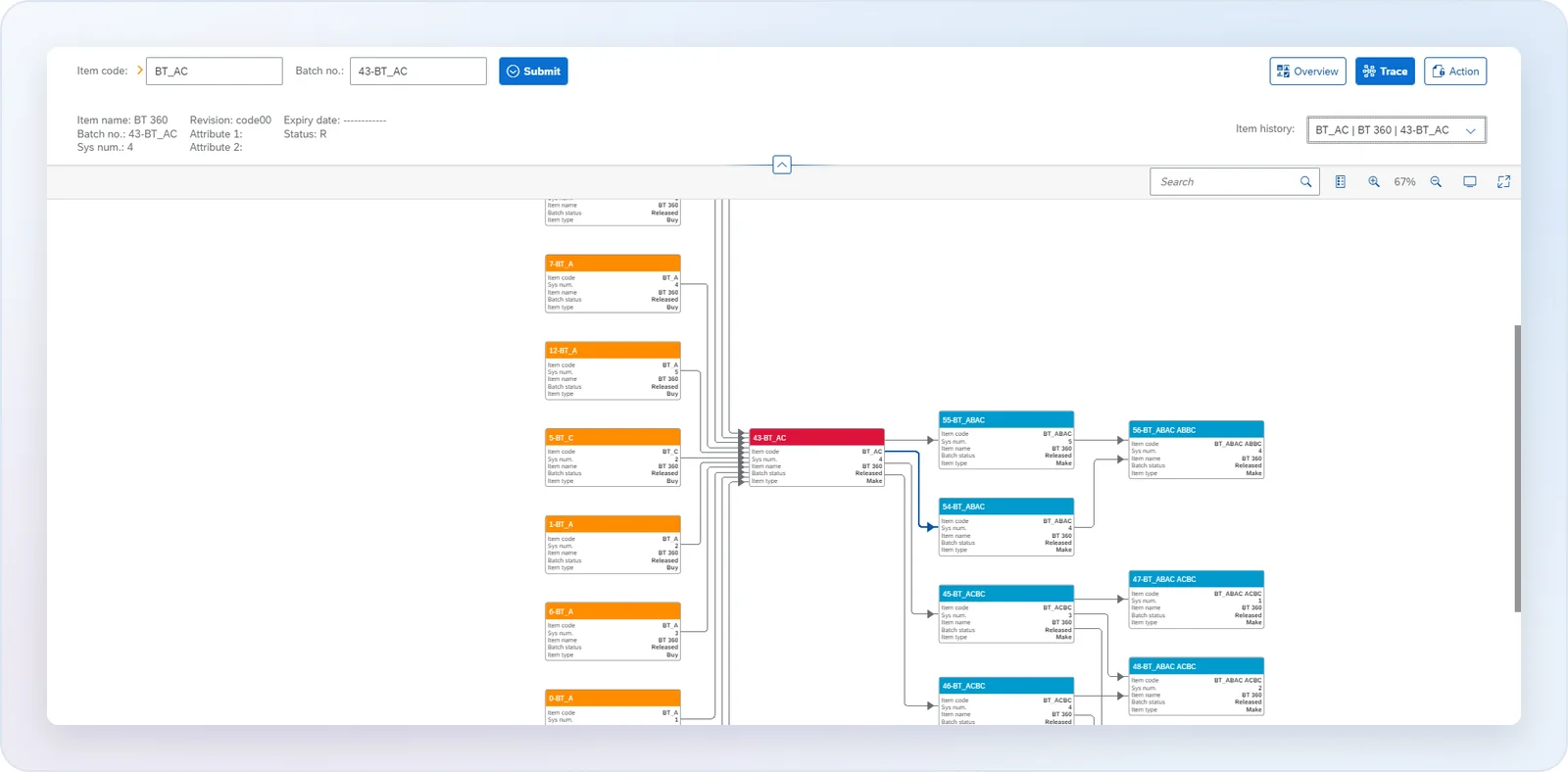
A trace is only as complete as the record of which lots went into each Manufacturing Order. With CompuTec PDC, operators register the raw materials they issue and the feed they produce on a touch screen at the line, and Issue to Production shows the quantity taken from each batch, so nobody has to write lot numbers down and type them in later.
Palital Feed Additives, a Dutch maker of coated feed additives, works this way with CompuTec ProcessForce and CompuTec PDC: each batch stays locked until its quality department and laboratory release it, and Palital can follow a batch from raw material to end product and back in minutes. Their customer story describes how they set it up with their implementation partner, Logres.
Where a buyer needs the mycotoxin figures, which the recommendation expects when a value is exceeded, a Certificate of Analysis can be generated from the test results for that batch, so the figures you send are the ones your laboratory recorded.
Our Agribusiness page covers how CompuTec solutions support feed, crop input, and agri-processing manufacturers more broadly, and our Quality Control page describes the testing functionality in full. You can also request a demo to see these tests set up for the raw materials you buy.