Yield is a very common requirement across many process and semi-process manufacturing industries, and on the surface it looks very simple, but how enterprises manage yield varies considerably depending on the raw materials being consumed, the product or products being produced, and the production process.
Some enterprises plan for yield to increase the amount of specific or all raw materials and production time to be consumed, while others do not plan, but wish to only analyze yield.
In industries such as food and beverage, chemicals, and life sciences, the raw materials and ingredients being consumed within the recipe or the formulation may have slight variations across the different batches, such as color, grade, or strength. In this environment, how do you manage yield?
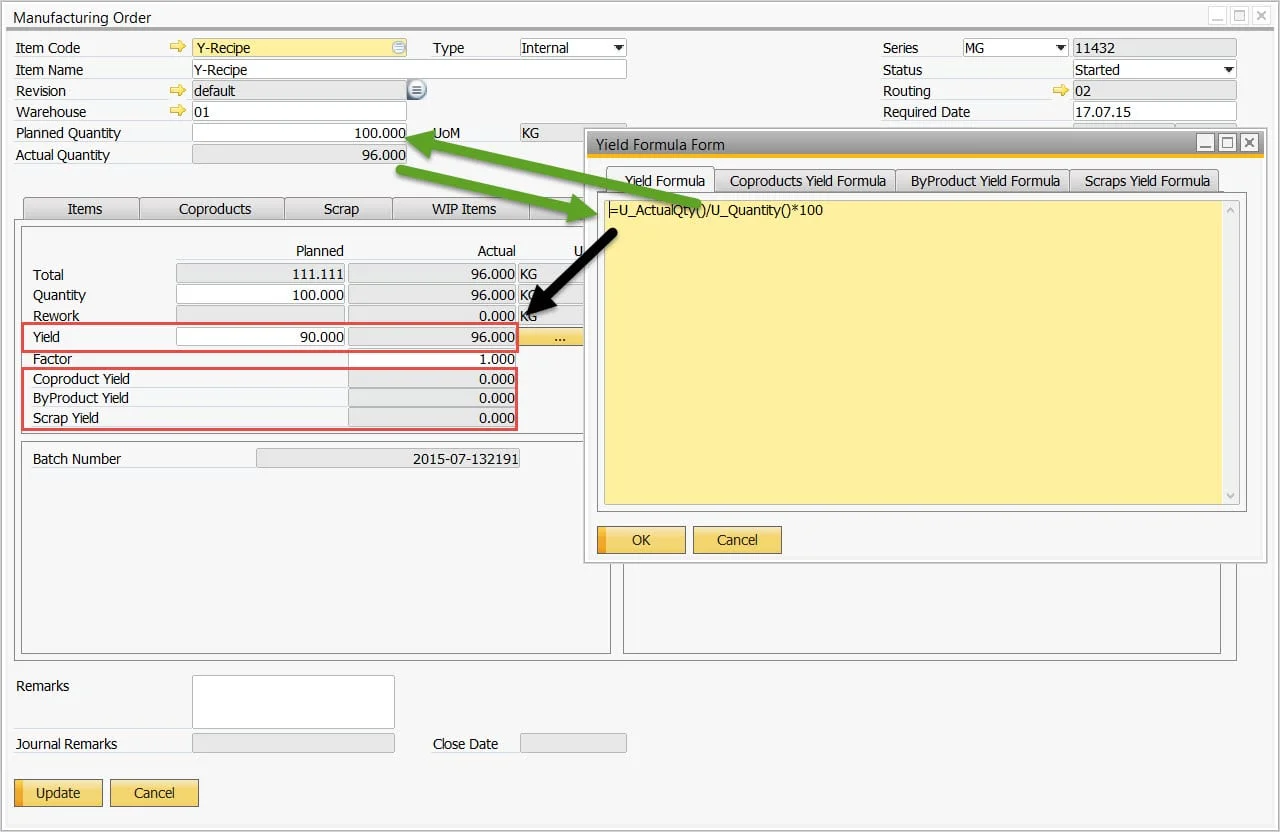
Some enterprises keep it simple by just comparing the planned vs. actual quantity of the product being produced within the Manufacturing Order. Another enterprise may compare the actual quantity of the produced product vs. the consumed amount of a specific raw material or ingredient. Yet another may compare the produced quantity of co-products, by-products, and scrap, and calculate a separate yield for each of the production outputs.
Yield Planning
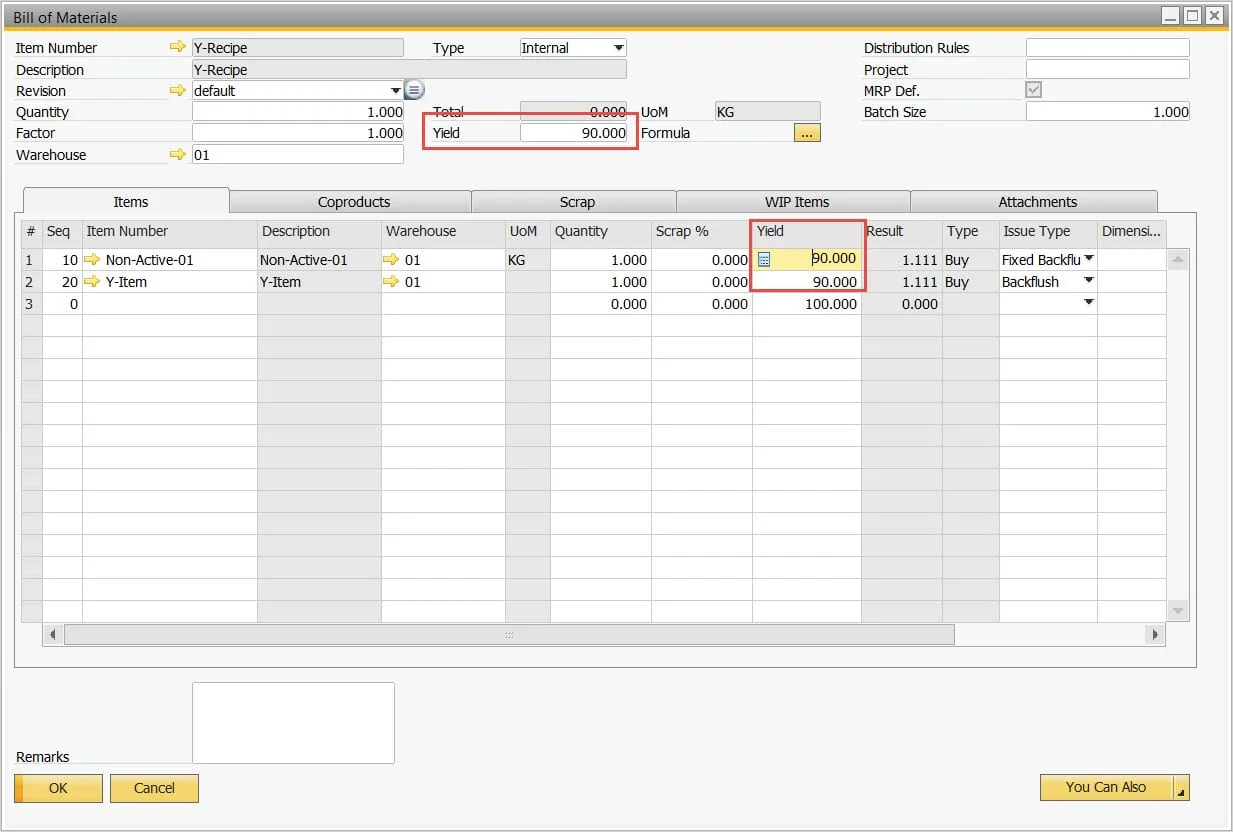
Defining the planned yield for a product is a matter of applying a percentage to the recipe or formulation to uplift the raw material quantities to be issued to production. But for added flexibility, an additional yield percentage can be defined at the ingredient level.
Yield Analysis
This is where it starts to get complicated, as there are many different methods for determining the actual yield for analysis purposes. The table below provides some different examples.
| Yield Basis | Yield Comparison |
|---|---|
| Parent Item | Parent Item Planned vs. Actual Production Quantity |
| Parent Item | Parent Item Planned vs. Actual Production Quantity – Co-Products – Scrap |
| Raw Material | Consumed Raw Material(s) vs. Actual Parent Item Production Quantity |
| Raw Material | Consumed Raw Material(s) vs. Actual Parent Item Production Quantity – By-Products – Scrap |
Solution
During most ERP implementations, custom code development is required to meet the customer’s yield analysis calculation methods. But using the CompuTec ProcessForce yield “formula” methodology, the customer has full flexibility to define how actual yield is calculated per recipe and formulation, without the need to invest in custom code development, thus lowering the total cost of ownership.